A lesson from History
First published in Facebook April 2026
Why the EU has refused Trump’s demand (and threats) to send warships to the Straits of Hormuz: a lesson from History
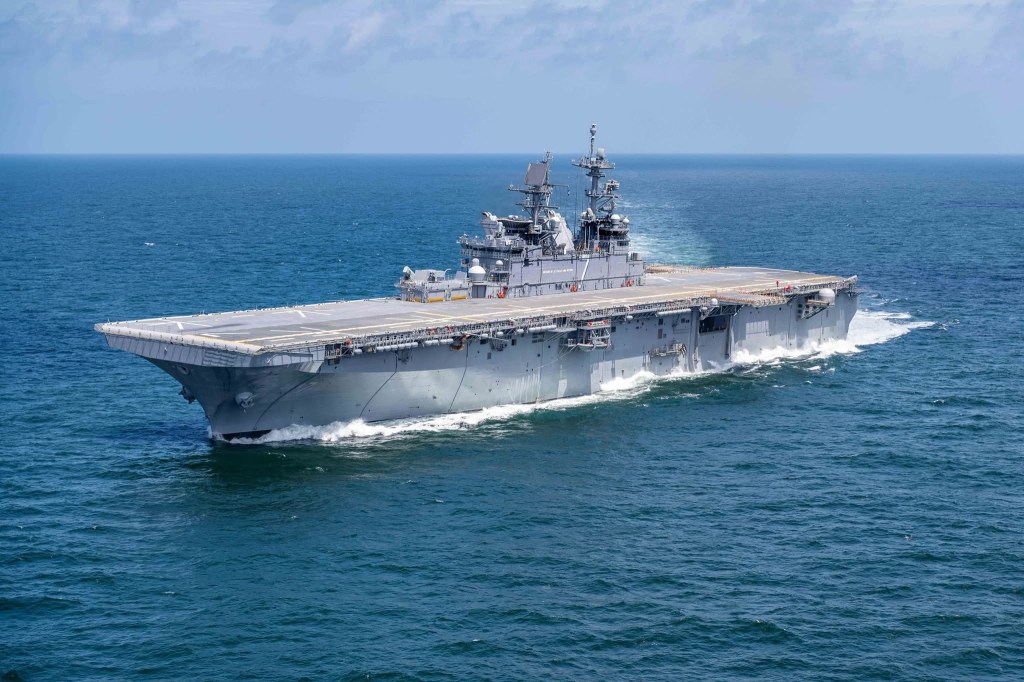
On 3rd April it was reported that the USS Tripoli, an amphibious assault ship with a flight deck capable of supporting a variety of modern US aircraft and helicopters including the advanced F-35B, and up to 2,500 marines, is approaching the Straits of Hormuz. Other US naval and airborne forces are also en route for that destination.
The Straits are about 104 miles long. At their widest point they are about 60 miles apart; but they narrow sharply to between 24 and 14 miles (depending on how they are measured) in the vicinity of Bandar Abbas on the Iranian side of the Straits, and the peninsular of Ra’s Musandam in northern Oman. The two main shipping lanes through the Straits are substantially narrower and closer to shore.
It has been assumed that the USS Tripoli is intended to lead an attempt to ‘open’ the Straits and allow oil tankers to exit into the Gulf of Oman. Most recently President Trump demanded that Europe and the UK should send their own naval forces to assist the USA in this operation or he would withdraw the USA from the NATO Alliance. Although PM Starmer had already capitulated to Trump in allowing US bombers to use our Fairford and Lakenheath air bases to pulverise Iran’s civilians (defensively, of course), for Starmer this was one step of subservience too far. Even Starmer and his entourage must be aware of the lesson from history.
The lesson: The 41-mile-long Dardanelles Straits connect the Aegean Sea with the Sea of Marmara across which lies the Bosphorus and Istanbul, formerly Constantinople and the capital of the Ottoman (Turkish) Empire. At the outbreak of the First World War, even before the Ottomans had declared war on the Allies (Britain, France and Russia), the German officer who had been placed in command of the Dardanelles fortifications ordered the Straits to be closed.
In February 1915, after the Ottomans had joined the Central Powers (Austria and Germany) in their war against the Allies, Winston Churchill, First Lord of the Admiralty, sent a powerful Anglo-French flotilla to force the Dardanelles Straits, cross the Sea of Marmara, and capture Istanbul, effectively, knocking the Turks out of the War.
After two desultory attempts to neutralise the Ottoman shore defences and minefields in which the cruiser Amethyst and a number of minesweepers were damaged or sunk, the main battle began on 18the March when Admiral John de Robeck sent an eighteen-strong flotilla of British and French capital ships, supported by a fleet of smaller warships, to force the Dardanelles. It was to be a battle between heavily gunned Allied warships and Ottoman shore-defences and between Turkish minefields and British minesweepers converted from North Sea trawlers.
It wasn’t long before disaster struck. Around mid-day on the 18th March the British battleship Agamemnon and battlecruiser Inflexible together with the French warships Gaulois and Suffren were all hit by Turkish shore batteries and badly damaged. Then, at 2.00 pm the French battleship Bouvet struck a mine, capsized and sank almost immediately, losing all hands. Two hours later the British battlecruiser Inflexible also struck a mine with 30 crew members killed. It remained afloat but later had to be beached. Soon afterwards another British battleship, Irresistible, was mined and began to drift aimlessly. Admiral de Robeck ordered Irreristible’s crew to be taken-off and another warship, the old pre-dreadnought Ocean, to take her in tow, but because of the shallow depth of the channel at that point Ocean was unable to comply. Later, at around 6,00pm Ocean herself hit a mine, jamming its steering gear and leaving her too to drift out of control. All the ships badly damaged by mines later sank.
By the evening, de Robeck was forced to order a complete withdrawal. For a tiny number of dead Ottoman gunners and a few small, antiquated Turkish warships, the British and French had lost three battleships, three others badly damaged, and suffered more than seven hundred casualties. It was the only, and last, attempt to force the Dardanelles Straits.
As a result, the Admiralty declared that ground troops were essential, to land on the Gallipoli Peninsula and take the Ottoman shore defences in the rear. Only then could the Anglo-French flotilla be able to proceed through the Dardanelles to the Sea of Marmara and Istanbul. Thereafter, the ill-fated Gallipoli campaign commenced, ending in defeat, withdrawal, and tens of thousands of British, Australian and New Zealand infantry casualties.
So, let’s, hypothetically, consider a US-lead ‘Allied’ combined operations campaign in 2026 to ‘open’ the Straits of Hormuz, and compare it with the Dardanelles campaign of 1915. Obviously there has been a huge advance in military technology since that earlier event. Ships like the USS Tripoli now have a wealth of offensive and defensive assets. Nevertheless, in a repetition of 1915, Iranian minefields could still ‘take out’ Western capital ships, tiny and fast Iranian MTBs emerging from well-hidden coves, would hit them with their missiles, and the recent and surprising emergence of the drone as a weapon of war has completely overturned the offensive/defensive balance. Today a single Iranian revolutionary guard can cripple an enemy warship trying to enter the Straits of Hormuz by firing drones from his own back garden, hundreds of miles away. Unfortunately for the USA and any naval ‘allies’ accompanying it, it would be like shooting ducks in a barrel.